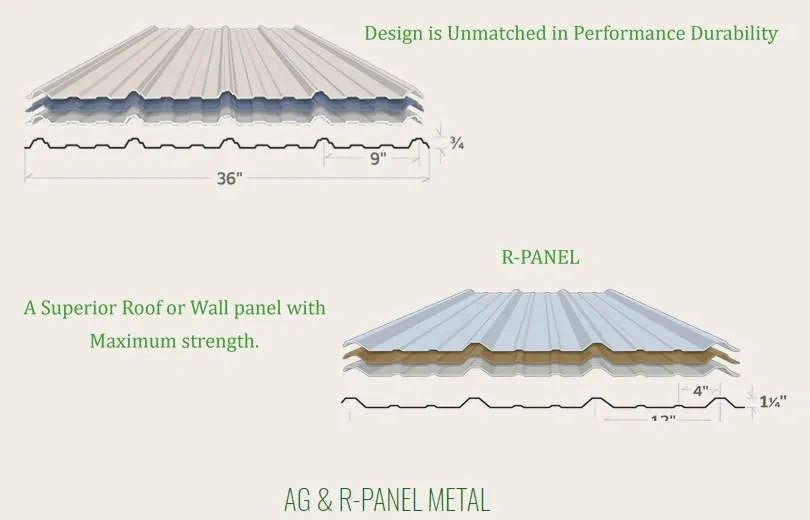
AG Panel: AG panels, sometimes called pole barn metal, is primarily used for residential and other non-commercial buildings. The panel consists of 5 major ribs at 3/4" with 2 minor rib in between to ensure a flat consistent panel. 2-3 ft spacing is the recommended distance between firring strips or purlins, this limits its commercial use on larger structures. This panel can be made in 29, 26 or 24 gauge but AG panel is primarily produced in 29 gauge. AG panel has many names and variations, but whatever the name AG Panel is a strong, durable and beautiful.
PBR panel: PBR panels, which stands for Purlin bearing rib, has residential and commercial appeal, due to is strength and is ideal for larger spans. The panel, like AG, consists of 4 major ribs with 2 minor ribs in between to ensure a flat consistent panel, PBR has 1 1/4" major ribs to provide the added strength. 5-6 ft spacing between purlins allows less steel to be used for the structure and allows for larger buildings. PBR [panels can be made in 29,26,24 and 22 gauge but primarily made in 26 and 24 gauge. PBR panels allow for ease of install with panels being easily strong enough to maneuver on, it has a more industrial look than the AG panel but is still a beautiful option.
AG Panels:
Design: Corrugated or ribbed.
Application: Agricultural buildings, storage facilities, canopies.
Strength: Less strong than PBR panels.
Appearance: Clean, simple, and more modern than PBR panels.
Cost: Generally more affordable.
PBR Panels:
Design: Purlin Bearing Rib, larger overlap section.
Application: Commercial and industrial buildings, where structural strength is crucial.
Strength: Stronger connection due to larger overlap, more weather-tight.
Appearance: Less modern than AG panels.
Cost: Can be more expensive than AG panels. ag panel vs pbr panel ag pbr metal panel AG PBR metal panel